Abbotts
Lagoon is proof that good things do come
in small packages, and that short hikes can be as exciting and eventful
(or quiet and peaceful) as long ones. After visiting Chimney Rock in the
spring of 2000, I decided to take a quick hike at Abbotts Lagoon before
heading home. I'm glad I did, because Abbotts Lagoon had a calm and bucolic
vibe, while the mood at Chimney Rock was frenzied. There were too many
people at Chimney Rock; only a few hikers at the lagoon. Wildflower spotting
can seem like a competitive sport at Chimney Rock, with cameras slung
over aficionados' shoulders like weapons. At Abbotts Lagoon, I saw wildflowers
in abundance along the sides of the trail, and in one secret spot where
 I stood in quiet solitude and awe at the wonder of spring blossoms.
A lagoon, according to the interpretative
display at the trailhead, is "a brackish water lake separated from
the ocean by a narrow strip of beach." Abbotts Lagoon is comprised of a north wing and a south
wing, and the only trail here runs between the wings, then crosses a bridge
and heads through the sand to the ocean. For the first 1 mile only the
north wing is visible from the trail; views of the south wing are blocked
by hills to the south. This is one hike where you may want to wear slip-on
shoes or sport sandals. Hiking boots and sand do not mix well. In the
winter, expect cold, muddy, and windy conditions. Spring, when the wildflowers
are blooming, is the best time for a visit. The weather on Point Reyes
is notoriously unpredictable, so you may want to check current conditions
with the ranger station at Bear Valley (415-464-5100) before heading out.
Start at the interpretative display at the
trailhead, where you can learn more about this lagoon and the abundant
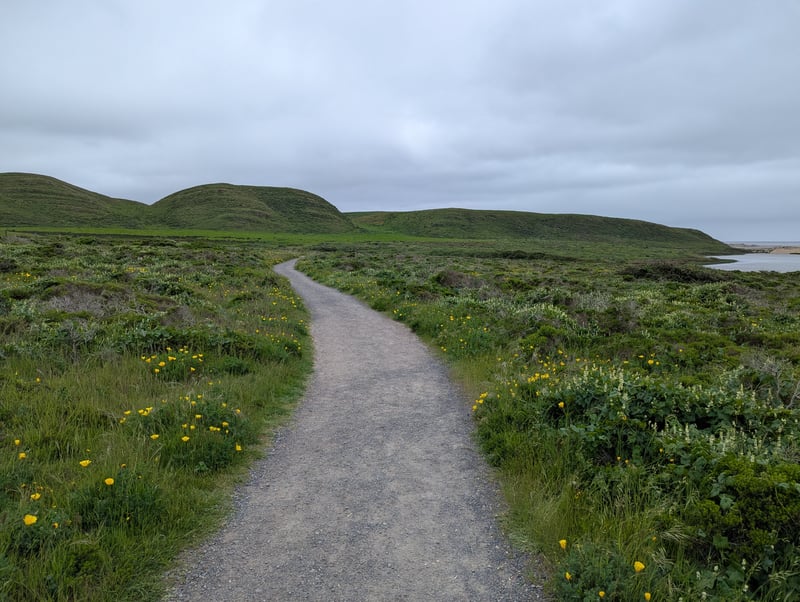
wildlife that thrives here. As you start down the narrow, flat trail, in spring you may notice
poppies, wild radish, yellow bush lupine, checker-blooms, and fiddlenecks.
A bench on the left side of the trail just before a bridge is a fine place
to sit and birdwatch. You might see red-winged blackbirds and
California quail. Both have distinctive calls and love to sit on fenceposts.
The north wing of the lagoon is visible to the right. Salmonberries, which
 are uncommon in the bay area, grow in a large hedge on the right side of
the trail. Look for the distinctive pink-purple blossoms in April, and
then fruit later in May. At 0.45 mile, there's a second bench, and the
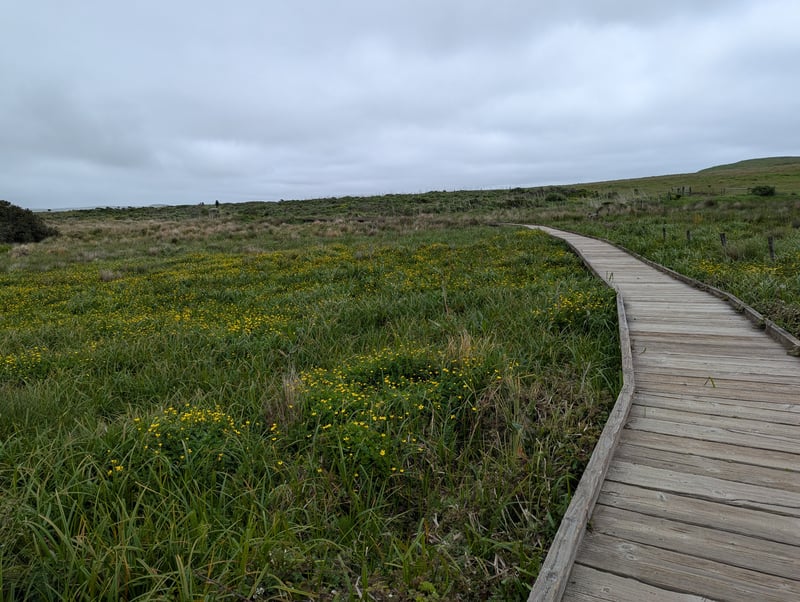
trail transitions from crushed gravel to dirt. Soon after the trail narrows
and a boardwalk rises above a damp stretch. Pre-boardwalk construction, I used to
see garter snakes and frogs here. The trail returns to dirt
and edges along the fence line. Cattle are usually grazing on the ranch
land on the left. Lots of poppies grow along the trail in the spring,
but also look for mission bells, Douglas iris, and baby blue-eyes. On an August hike, I watched a great blue heron
and great egret fishing. A few steps later, I spotted a juvenile black-crowned night heron. At 1.1 miles,
a bridge crosses over the confluence of the north and south wings of the
lagoon. After this, the path (such as it is) crosses through loose sand
the final 0.2 mile to the ocean. (Continue to the beach if you like, and
retrace your steps to the bridge.) Before the bridge, near a horse hitching
post, look to the left for a faint, unmarked path.
are uncommon in the bay area, grow in a large hedge on the right side of
the trail. Look for the distinctive pink-purple blossoms in April, and
then fruit later in May. At 0.45 mile, there's a second bench, and the
trail transitions from crushed gravel to dirt. Soon after the trail narrows
and a boardwalk rises above a damp stretch. Pre-boardwalk construction, I used to
see garter snakes and frogs here. The trail returns to dirt
and edges along the fence line. Cattle are usually grazing on the ranch
land on the left. Lots of poppies grow along the trail in the spring,
but also look for mission bells, Douglas iris, and baby blue-eyes. On an August hike, I watched a great blue heron
and great egret fishing. A few steps later, I spotted a juvenile black-crowned night heron. At 1.1 miles,
a bridge crosses over the confluence of the north and south wings of the
lagoon. After this, the path (such as it is) crosses through loose sand
the final 0.2 mile to the ocean. (Continue to the beach if you like, and
retrace your steps to the bridge.) Before the bridge, near a horse hitching
post, look to the left for a faint, unmarked path.
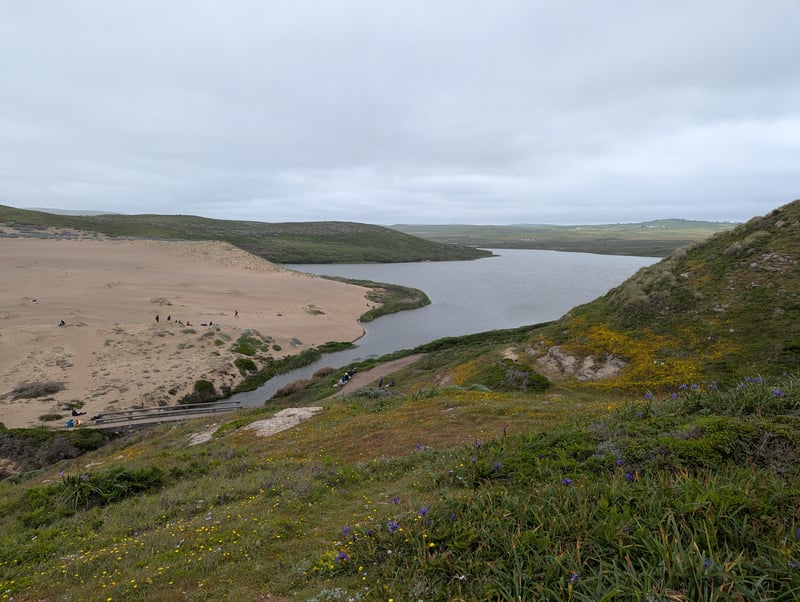
Carefully climb uphill on the trail that leads
to a small bluff overlooking both wings of the lagoon and the ocean.
In spring, the bluff is heavily sprinkled with wildflowers,
including pussy ears, lupines, California buttercups, blue-eyed grass,
and goldenfields. On a mid-April hike, the side of the hill facing west
was thoroughly carpeted with goldenfields. It's an amazing spot, and for
me it was even more enjoyable to have it to myself for just a few minutes.
Please stay on the path and don't trample the flowers. When you're ready to continue,
retrace your steps back to the trailhead.
Total mileage: 2.3 miles
Last hiked: April 19, 2025
Previous visit: August 23, 2021; April 29, 2002; and April 19, 2000